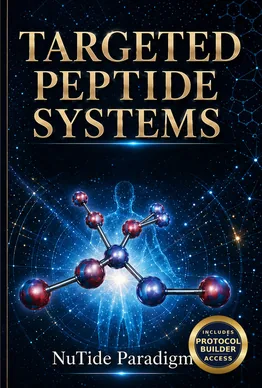
The foundation volume.
Ninety-plus compound profiles and the framework that holds them together — how peptides map to the body’s signalling systems, how compounds stack, and how to think in protocols instead of one-off compounds. Every other book in the series takes one system out of this one and goes as deep as a full volume allows.
$9.99Instant EPUB and PDF direct from the publisher. The 373-page print edition is returning through bookshops, libraries and wholesalers. Educational purposes only. Not medical advice.
The information is not missing. It just doesn’t agree with itself.
The same compound gets described three different ways on three different pages. Dosing figures turn up with no indication of where they came from. Forum posts, supplier marketing and genuine clinical research sit side by side, formatted identically, with nothing to tell you which is which. So you can read for a month and still not be able to answer a simple question: given what I am actually trying to change, what belongs in the protocol and in what order?
That question is the whole subject of this book. It is organised around the body’s signalling systems rather than around a shopping list, so a compound is never introduced in isolation — it arrives attached to the system it acts on, the compounds it conflicts with, and the reasoning that puts it where it sits in a sequence.
One framework, one vocabulary, one set of numbers that agree with each other. Everything else in the series is built on it.
You’ll get the most out of this if…
- You are new to peptides and want the whole map before committing to any one part of it.
- You already use one or two compounds and want to understand what else is in the picture and how it fits together.
- You want one reference you can keep going back to — ninety-plus profiles in a single volume rather than ninety-plus browser tabs.
- You want to understand reconstitution, dosing arithmetic and handling properly, since that is where most avoidable mistakes happen.
- You want the evidence graded honestly, including the compounds where the human data barely exists.
It is a framework book, not a set of instructions. It explains mechanisms, tradeoffs and reasoning — it does not tell you what to take, and it is not a substitute for medical care.
Ten sections, front to back.
- I Foundations of Peptide Science and Precision Therapeutics
- VI Multi-Peptide Usage Dynamics and Systems Integration
- II Peptide Administration, Handling and Reconstitution
- VII Peptide Cycles, Timing and Optimization
- III Core Peptide Categories and Clinical Applications
- VIII Long-Term Use Considerations and Risk Mitigation
- IV Individual Peptide Profiles — Comprehensive Reference
- IX Case-Based Applications and Personalized Protocol Design
- V Bioregulators and Epigenetic Peptide Modulation
- X The Future of Precision Peptide Engineering
Plus the reference material
A quick-reference guide, consolidated appendix tables, sourcing guidelines, and protocol tracking worksheets — a weekly administration tracker, an administration timing log, and a notes and observations sheet.
Eight functional categories.
Section III sorts the field by what a compound is actually for, so that choosing one becomes a question of which system you mean to reach rather than which name you happen to have read about.
- 1 Growth hormone secretagogues
- 2 Tissue repair and regenerative peptides
- 3 Metabolic and body composition peptides
- 4 Immune-modulating peptides
- 5 Neuroactive and cognitive peptides
- 6 Anti-inflammatory and cytoprotective peptides
- 7 Hormonal axis modulators
- 8 Vascular and cardiometabolic peptides
Sixty peptides. Thirty-one bioregulators.
Section IV runs A to Z, and each profile follows the same structure — classification and receptor target, mechanism of action, clinical and research applications, administration route, dosing considerations, cycling guidance and safety profile. Section V then does the same for the bioregulators.
Section IV — sixty individual peptide profiles
Section V — thirty-one bioregulator profiles
Then go as deep as you need on one system.
This book is the map. Each of the others takes a single system off it and spends a whole volume there — more compounds, more mechanism, worked case models and protocol design specific to that system. You do not need them to use this one, and you do not need this one to use them.
32 profiles across eight categories, built around what actually crosses the blood-brain barrier.
35 profiles — the incretin class, the growth-hormone axis and the mitochondria, and how they interact.
40 profiles, and the immune gate that decides whether repair happens at all.
Amazon removed this one. Read what happened →
Targeted Peptide Systems
The complete foundation volume — all ten sections, all ninety-plus compound profiles, the quick-reference guide and the tracking worksheets.
$9.99 Instant EPUB and PDF. Read it tonight.Want to try the framework first? The Protocol Builder and the Peptide Dose Calculator are free, with nothing to sign up for.
Questions.
Which book should I start with?
This one, if you want the whole map before going deep on any part of it — it is the widest reference in the series and everything else builds on its framework. If you already know exactly which system you care about, start with that volume instead. Every book re-establishes the framework it needs, so none of them depends on another.
Does it overlap with the other books?
The framework is shared by design, so the vocabulary and the reasoning carry across. The compound coverage is where they differ: this book profiles more than ninety compounds broadly, while each specialist volume goes considerably deeper on its own system, adds compounds this one does not cover, and includes worked case models and protocol design specific to that system.
Which compounds does it cover?
Sixty individual peptide profiles in Section IV, running A to Z from ACTH through to VIP — including BPC-157, GHK-Cu, the GLOW and KLOW blends, the GLP-1 compounds, the growth-hormone secretagogues, Semax, Selank, Epitalon and the mitochondrial compounds. Section V then profiles thirty-one bioregulators, from Bonomarlot to Zhenoluten.
Is this a dosing guide?
It is a framework book with a reference section. Every profile carries dosing considerations, administration route, cycling guidance and a safety profile, and there is a quick-reference guide at the back. It does not prescribe, and it is not a substitute for medical care.
Does it cover reconstitution and handling?
Yes — Section II is given to administration, handling and reconstitution, including storage and stability, concentration and dosage arithmetic, and routes of administration. It is placed early on purpose, because that is where most avoidable mistakes happen.
What formats is it available in?
Instant EPUB and PDF download direct from the publisher for $9.99. The 373-page print edition is returning through bookshops, libraries and international wholesalers.
How current is the compound information?
Every compound in the series lives in a single database that also generates the compound library and the Protocol Builder on this site, so the book, the library and the tools describe each compound the same way rather than drifting apart. Evidence grades are stated on the compound itself rather than buried in a disclaimer.
Targeted Peptide Systems home →