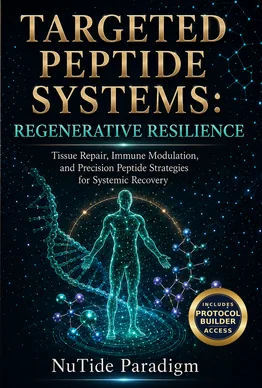
Regenerative Resilience
Precision Peptide Strategies for Injury Repair, Chronic Conditions, and Systemic Recovery
Injury, chronic inflammation, gut repair and the fibrotic pathway that turns healing into scar — treated as one sequence instead of a list of compounds. Why repair stalls, what has to be fixed before anything else can work, and how a recovery protocol is actually built.
$9.99Instant EPUB and PDF direct from the publisher. The 378-page print edition is returning through bookshops, libraries and wholesalers. Educational purposes only. Not medical advice.
When healing stalls, the problem is usually not the repair compound.
Healing is a sequence, not an event. Inflammation has to arrive, do its job and then resolve; macrophages have to switch from clearing damage to building tissue; the proliferative phase has to give way to remodelling. Miss a transition and you do not get failure — you get tissue that looks repaired and never works right again.
The transition that most often fails is the immune one. If the immune environment stays stuck in the inflammatory phase, the structural repair compounds everyone reaches for first have nothing to build on. That is why people run BPC-157 for months on a chronic problem and get a fraction of what they expected.
This book puts the immune system before the compound list. An entire section is given to the immune-repair interface — macrophage polarisation, cytokine networks, mucosal barrier integrity, and what to do when immune regulation is the thing that is broken. Only then does it get to what to take and in what order.
You’ll get the most out of this if…
- You have an injury that has not healed the way it should have, and want to understand what stalled rather than try another compound.
- You are already using BPC-157, TB-500 or GHK-Cu and want the framework that decides when each one belongs in the sequence.
- You are dealing with chronic inflammation or gut repair, where the immune picture matters more than the structural one.
- You want to understand fibrosis and senescence — why aged or chronically damaged tissue scars instead of rebuilding.
- You want the evidence graded honestly, including the compounds where the human data barely exists.
It is a framework book, not a set of instructions. It explains mechanisms, tradeoffs and reasoning — it does not tell you what to take, and it is not a substitute for medical care.
Ten sections, front to back.
- I Foundations of Regenerative Biology
- VI Stacking and Regenerative Protocol Design
- II The Immune-Repair Interface
- VII Cycles, Timing and Optimization
- III Core Regenerative Peptide Categories
- VIII Long-Term Use, Safety and Monitoring
- IV Individual Compound Profiles — Full Reference
- IX Case-Based Applications — Injury, Immune and Systemic Recovery
- V Bioregulators for Systemic Tissue Resilience
- X The Future of Regenerative Peptide Medicine
Plus the reference material
A quick-reference dosing guide for the full compound set, consolidated appendix frameworks, sourcing guidelines, and protocol tracking worksheets.
Forty profiles, sorted by what they act on.
Not an alphabetical list. Compounds are grouped by the part of the repair process they work on, so choosing one becomes a question of which stage you are actually trying to move.
1 — Structural repair peptides
2 — Immune modulation peptides
3 — Anti-fibrotic and senolytic peptides
4 — Anabolic and growth factor peptides
5 — Mitochondrial regeneration peptides
6 — Organ-specific bioregulators
Section V profiles all twenty bioregulators in full and then lists the complete catalog beyond them, with the annual rotation architecture for long-term use.
Regenerative Resilience
The complete book — all ten sections, every compound profile, the dosing guide and the tracking worksheets.
$9.99 Instant EPUB and PDF. Read it tonight.Want to try the framework first? The Protocol Builder and the Peptide Dose Calculator are free, with nothing to sign up for.
Questions.
Do I need to read the other books first?
No. Each book in the Targeted Peptide Systems series stands on its own and re-establishes the framework it needs. Book 1, Targeted Peptide Systems, is the foundation volume and goes wider across every system — but you can start here if injury, inflammation or recovery is what you actually came for.
Why does the book spend a whole section on the immune system?
Because immune regulation is the gate the rest of repair has to pass through. Macrophages have to switch from clearing damage to building tissue, and inflammation has to resolve rather than merely arrive. When that transition fails, structural repair compounds have nothing to build on — which is why chronic problems so often fail to respond to the compound that worked fine on an acute one. Section II covers the innate and adaptive systems, cytokine networks, macrophage polarisation and the mucosal barrier.
Which compounds does it actually cover?
Forty profiles across six categories — structural repair compounds including BPC-157, TB-4, TB-500, GHK-Cu and the GLOW and KLOW blends; immune modulators including Thymosin Alpha-1, KPV, VIP, LL-37 and ARA-290; anti-fibrotic and senolytic compounds B7-33 and FOXO4-DRI; IGF-1 and IGF-1 LR3; mitochondrial compounds SS-31, MOTS-c, Humanin and NAD+; and twenty organ-specific bioregulators in Section V.
Does it cover gut repair?
Yes. Mucosal barrier integrity is part of the immune section, and gastrointestinal mucosal restoration is one of the five worked case models in Section IX, alongside acute musculoskeletal injury, chronic joint degeneration, post-illness recovery and aging-associated decline.
Is this a dosing guide?
It is a framework book with a reference section. It explains what each compound acts on, how compounds interact, how cycles are structured and which biomarkers to watch, and it includes a quick-reference dosing guide drawn from the published literature. It does not prescribe, and it is not a substitute for medical care.
What formats is it available in?
Instant EPUB and PDF download direct from the publisher for $9.99. The 378-page print edition is returning through bookshops, libraries and international wholesalers.
How current is the compound information?
Every compound in the series lives in a single database that also generates the compound library and the Protocol Builder on this site, so the book, the library and the tools describe each compound the same way rather than drifting apart. Evidence grades are stated on the compound itself rather than buried in a disclaimer.
One framework. Every system.
Regenerative Resilience takes one system out of the foundation volume and goes as deep as a whole book allows. The others do the same for theirs.