We wrote these books so you could ask better questions
Two and a half years of research, and the part that mattered was never the compound list. Amazon banned the entire series and terminated our KDP publishing account across four notices, without once naming the content at issue.
Two and a half years went into this series. The question underneath all of it fits on a napkin: could someone be given enough understanding of their own biology to walk into a doctor’s office with a real question, instead of a screenshot from an influencer?
That is the whole project. Not a protocol to copy. Not a list of compounds with doses next to them and a wish of good luck.
The series is built as a system because biology works as one. Incretin signalling does not operate in a sealed room away from the growth hormone axis. Mitochondrial output and tissue repair are not separate topics that happen to share a book. When you understand how the pieces move against each other, you can start to work out which part of the picture is actually yours — and, more usefully, which part is not. That discernment is the work. It cannot be done for you by a chart, and it cannot be done for you by someone with an affiliate link.
Everybody should be empowered to ask questions of the people they have entrusted with their care. That is what this material is for. A large portion of these books is about maintaining your own biology through ordinary means — sleep, load, nutrition, the unglamorous things that move the needle before anything exotic enters the conversation. Nothing in them encourages anyone to leap.
The argument for keeping this out of your hands
Resistance to material like this has never really been about the material. It centres on people who would prefer this information stayed limited — kept away from anyone concerned enough about their own well-being to go looking for it. The reasoning offered runs roughly like this.
Information about compounds that alter human physiology, put in front of people without clinical training, produces harm. Someone reads a chapter, decides they have identified their own problem, and takes a risk they are not equipped to price.
We do not dismiss that. Harm does occur — and where it occurs, it is almost always the result of someone acting prematurely, moving before they had gathered the understanding they should have been seeking in the first place. Acting early is the failure. Reading is not.
Our biggest conflict with that line of thinking is the response it produces: restrict the information, on the reasoning that people who cannot evaluate it should not encounter it. That treats comprehension as a fixed property of a person, rather than something true understanding can change.
The relationship is upside down
Consider how the current arrangement actually works. You are expected to wait until a physician tells you a thing exists and is or is not appropriate for you. The conversation begins when they begin it. Your role is to receive a determination.
Now consider the alternative. You arrive having read carefully. You understand the mechanism well enough to know what you do not understand. You have a specific question, and a reason for asking it, and the humility to be told you have it wrong. Your physician now has a patient who can participate in a decision rather than simply consent to one.
The second version is not more dangerous than the first. It is more demanding. Demanding is not the same as unsafe.
Every meaningful advance in medicine started with somebody asking an inconvenient question about why a body was behaving a certain way. Curiosity is upstream of every treatment any of us has ever received. It is strange to treat it as a hazard when it appears in a patient.
What happened
It began with one book. The Longevity Map was pulled in August, and that story is told in full on its own page — what follows is how one banned book became a banned series.
- 8 Aug 2026The paperback of The Longevity Map is removed. The reason given points at the content. We ask which content.
- 11 Aug 2026The entire publishing account is suspended, citing that one title. Every book in the catalogue goes dark with it.
- Aug 2026The appeal is upheld. The first reason is dropped and replaced: the book looked like a “medication guidebook.”
- Aug 2026The account is reinstated on our written undertaking to unpublish any title not meeting the Content Guidelines. We ask which titles. No answer comes. The Longevity Map ebook is unpublished — that was the price.
- 5 Sep 2026The interior of Metabolic Precision is re-uploaded to correct page numbering. The text does not change.
- 7 Sep 2026The paperback of Metabolic Precision is removed.
- 9 Sep 2026The account is closed. Every remaining title is removed.
- 9 Sep 2026We appeal the same day. The appeal is closed and the decision stands.
We agreed to comply. We asked what to comply with.
The August reinstatement is the part of this that still does not sit right, and it is worth slowing down on, because everything after it follows from it.
The account came back on a condition. We had to confirm, in writing, that we would unpublish any title that did not meet the Content Guidelines. We gave that undertaking. Then we asked the only two questions that would let us honour it: which titles, and measured against what?
Neither was answered. Not then, not in the three weeks that followed, not in the notice that closed the account.
A written undertaking to remove unspecified titles, judged against an unnamed standard. That is not a compliance process. It is a promise to guess correctly.
Three weeks later we corrected page numbering on a different book. The words did not change; the numbers at the bottom of the pages did. Two days after that upload, that paperback was removed. Two days after the removal, the account was gone and the rest of the catalogue went with it.
Whether we breached the undertaking we had given, we genuinely cannot tell you. We were never told what it covered. A publisher who asks what to remove and gets no reply has not been given a rule to follow — they have been given a warning and a guess.
The objection was to a category, not to a book
Look at the shape of the reason that replaced the first one on appeal. The book, we were told, looked like a “medication guidebook.”
Not that a passage was wrong. Not that a figure was dangerous, or a mechanism misdescribed, or a citation misused. That it resembled a kind of book.
An objection to resemblance cannot be answered, because there is nothing in it to correct. You can fix an error. You cannot edit a book into not looking like a category. And an objection built that way tells you the review was of the shelf, not of the sentences on the shelf.
Across all four notices, no safety finding was ever made. No claim was identified as inaccurate. No passage was quoted back to us. And no reader had complained.
The reason was always the content
Four notices over five weeks. Strip away the wording and each one came back to the same place: the content. Not a passage of it. Not a claim in it. The content.
-
August · first noticeThe content. No page, paragraph or claim was named. Withdrawn on appeal.
-
August · on appealThe content, now characterised as resembling a
medication guidebook.
An objection to a category of book. Still nothing inside the book identified. -
7 SeptemberThe content. We asked which content. No answer came.
-
9 September · account closedThe content. No standard was named that the books could be measured against.
Not one of them pointed at anything we could have gone and fixed. That is the part that has stayed with us — not the decision itself. A retailer can carry or decline whatever it likes, and that is entirely its business. What is hard to accept is a decision delivered with no evidence attached and no route to examine it.
What we can show you is the record: every title, every identifier, and every figure we managed to capture before the listings disappeared. It is further down this page.
What we think, and we will mark it as what it is
We do not know why this happened. Nobody has told us, and we are not going to present a guess as a finding.
What we believe — stated as belief — is that what sits at the centre of this is material that hands people the means to reason about their own physiology, and to take that reasoning and that understanding to others when they are seeking guidance. That capability is uncomfortable for anyone whose position depends on being the only one in the conversation who understands the mechanism.
The outcome is consistent with that. If the aim had been correction, there would have been something to correct — a passage, a figure, a claim. We asked for exactly that at every stage, and the answer was always the content as a whole. Correction was never on the table. Once the content was judged not to belong on the platform, the account followed.
We might be wrong. We would genuinely rather be told we are wrong, with specifics, than continue guessing. The question has been open since 8 August.
Knowledge has always had gatekeepers
Being able to express what you understand, and to hand it to someone else, is part of the bedrock of any society that improves over time. It is how medicine advanced. It is how anything advanced.
For most of human history, the people who held knowledge were also the gate through which it passed. Progress moved at whatever speed the gatekeepers permitted. Sometimes that custody was careful and sometimes it was self-interested, but the effect was the same: what ordinary people could know about their own bodies was decided by somebody else.
Enlighten the people generally, and tyranny and oppressions of body and mind will vanish like evil spirits at the dawn of day. Thomas Jefferson, letter to Pierre Samuel du Pont de Nemours, 24 April 1816
Jefferson called the diffusion of knowledge among ordinary people the instrument by which things improve. He put oppressions of body alongside oppressions of mind, and that pairing is worth noticing — he was not describing an abstraction.
That is the work we took on. We gathered what we could understand and wrote it down so that other people could reason about their own biology, arrive at their own decisions, and stop waiting to be told. Much of that comes back to ordinary maintenance — sleep, load, nutrition, the unspectacular things — because that is where most of the available benefit actually sits. Sharing it is the entire point.
One practical thing, for anyone publishing independently
Our Amazon KDP listings are gone. Product pages return errors, and the sales history, rankings and reviews went with them, because all of it lived on someone else’s platform.
One thing survived, because of a decision made months earlier for unremarkable reasons.
Buy your own ISBNs. Every print title in this series carries an identifier registered to NuTide Paradigm in our own name. Not “Independently published,” and not an identifier issued by a retailer that disappears when the account does.
They cost roughly thirty dollars each. That is the difference between losing your listings and losing your body of work.
The record
Here is every one of them. Six titles, the identifiers that still belong to us, the addresses each listing held, and what happened to each book. It is not a defence of the books. It is the record — and it is the only part of any of this that anyone was ever able to verify.
| Title | ISBN | Published | Recorded rating |
|---|---|---|---|
Targeted Peptide Systems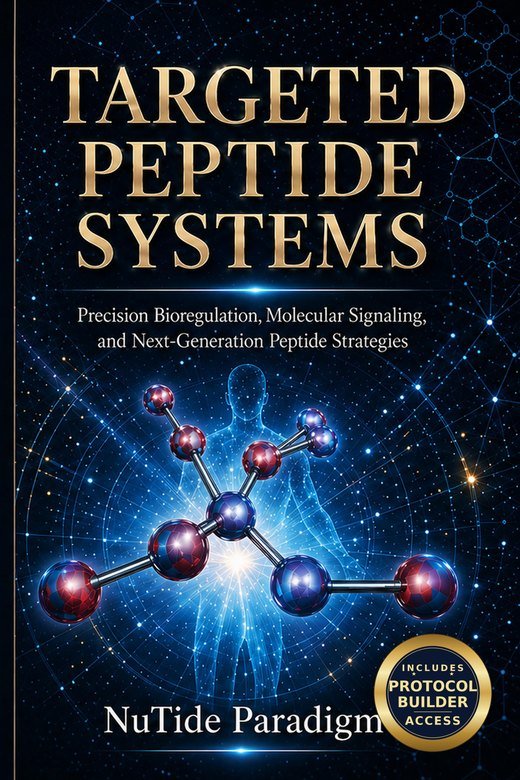 | 979-8-234-03090-0 | 1 April 2026 | 4.7 ★ · 55 ratings |
The Cognitive Advantage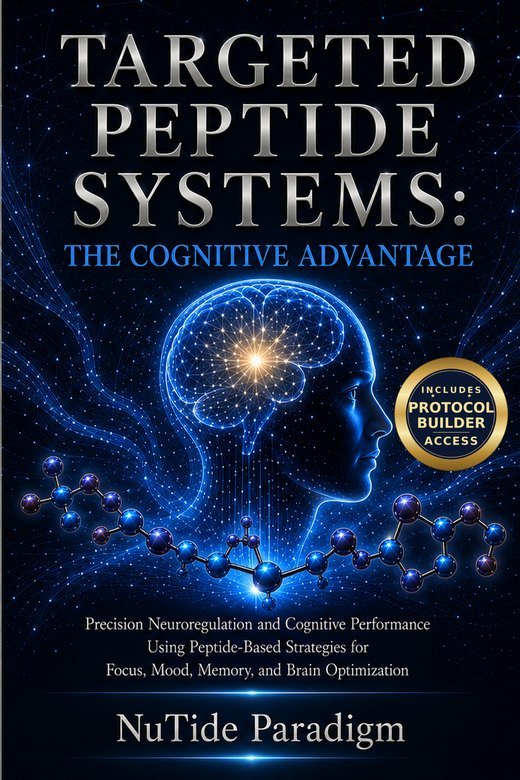 | 979-8-9962244-0-1 | 25 May 2026 | 4.5 ★ · 21 ratings |
Metabolic Precision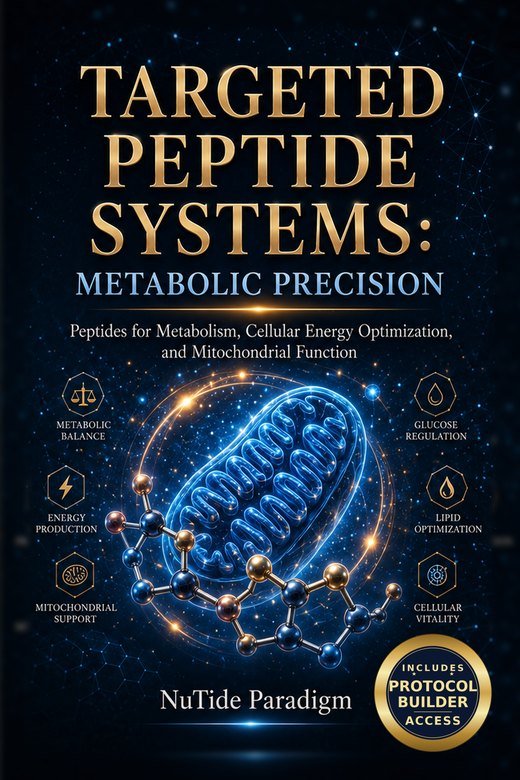 | 979-8-9962244-1-8 | 24 June 2026 | not recovered |
Regenerative Resilience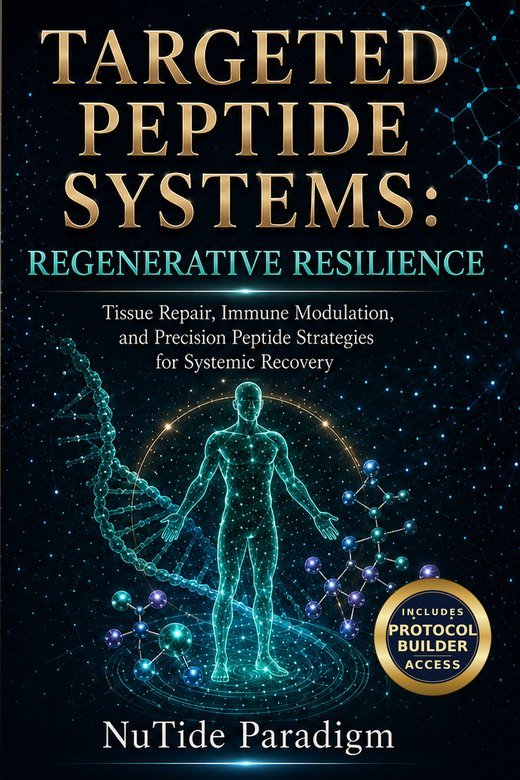 | 979-8-9962244-4-9 | 3 August 2026 | 5.0 ★ · 7 ratings |
The Longevity Map | 979-8-9962244-5-6 | — | not recovered |
Targeted Peptide Systems Tracker | — | 2 May 2026 | 5.0 ★ · 1 ratings |
Targeted Peptide Systems
Precision Bioregulation, Molecular Signaling, and Next Generation Peptide Strategies
The foundation volume, and the last of the series to be recorded before the listings went. Its product page was captured on 11 September, the day after the account closed and while the page was still being served. The figures below are that capture. Removed 9 September with the rest of the catalogue.
- ISBN-13979-8-234-03090-0
- Published1 April 2026
- Pages372
- Trim6 × 9 in
amazon.com/dp/B0GT5ZG8JSRemovedamazon.com/dp/B0GSXMGWZZRemoved
Printed as text, not links — these addresses no longer lead to a listing.
The Cognitive Advantage
Precision Neuroregulation and Cognitive Performance Using Peptide-Based Strategies for Brain Optimization, Health, and Repair
The longest book in the series at 432 pages. Its rating was recovered from a surviving copy of the product page rather than from a live capture. Removed 9 September with the rest of the catalogue.
- ISBN-13979-8-9962244-0-1
- Published25 May 2026
- Pages432
- Trim6 × 9 in
amazon.com/dp/B0H2W57LSFRemovedamazon.com/dp/B0H2T7K8F2Removedamazon.co.uk/dp/B0H2W57LSFHTTP 404
Printed as text, not links — these addresses no longer lead to a listing. The UK address was opened in a browser on 11 September 2026 and returned Amazon’s own page not found response.
Metabolic Precision
Peptides for Metabolism, Cellular Energy Optimization, and Mitochondrial Function
The title whose interior was re-uploaded on 5 September to fix page numbering. Two days later the paperback was gone. Its dashboard still read Blocked against the paperback and Draft — unpublished against the ebook, which the publisher had withdrawn in August. No customer rating was recovered before removal. Paperback removed 7 September, two days after a page-numbering fix.
- ISBN-13979-8-9962244-1-8
- Published24 June 2026
- Pages389
- Trim6 × 9 in
amazon.com/dp/B0H6HL23BBRemovedamazon.com/dp/B0H6GQ3WWYRemoved
Printed as text, not links — these addresses no longer lead to a listing.
Regenerative Resilience
Precision Peptide Strategies for Injury Repair, Chronic Conditions, and Systemic Recovery
Published on 3 August, five weeks before the account closed, and removed before it had a full trading quarter. Removed 9 September with the rest of the catalogue.
- ISBN-13979-8-9962244-4-9
- Published3 August 2026
- Pages378
- Trim6 × 9 in
amazon.com/dp/B0HCR95XCTRemovedamazon.com/dp/B0HCRD5MJZRemoved
Printed as text, not links — these addresses no longer lead to a listing.
The Longevity Map
Peptides and Bioregulators for Longevity after 50: a Healthspan Map for Cellular Repair, Energy, and Aging Well
Where this started. The paperback was the first thing removed, and this was the title cited three days later when the whole account was suspended. The ebook came down as the condition of getting the account back. No rating survived. The full account of this one title is on its own page. Paperback removed 8 August. The first removal.
- ISBN-13979-8-9962244-5-6
- Pages212
- Trim6 × 9 in
amazon.com/dp/B0HDB12CGDRemoved
Printed as text, not links — these addresses no longer lead to a listing.
Targeted Peptide Systems Tracker
A Systems-Based Framework for Peptide Protocol Tracking, Readiness Mapping, and Response Validation
The companion workbook — 132 printable pages at 8.5 × 11, not a reading book. It carried no peptide guidance of its own, and it was removed with everything else. Removed 9 September with the rest of the catalogue.
- Published2 May 2026
- Pages132
- Trim8.5 × 11 in
amazon.com/dp/B0GZKJ444VRemoved
Printed as text, not links — these addresses no longer lead to a listing.
Where the books are
The series is available directly from us — ebooks with the Protocol Builder included, and print returning through this site as well as through bookshops, libraries and international wholesalers.
Everything above is there to be checked. The books themselves are there to be read.
None of this changes what the books are for. Read carefully, decide slowly, and take what you have understood to someone qualified to argue with you about it. That was the point on the first day of the first draft, and it is still the point.