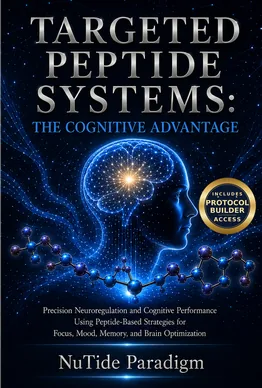
The Cognitive Advantage
Precision Neuroregulation and Cognitive Performance Using Peptide-Based Strategies for Brain Optimization, Health, and Repair
Focus, memory, mood, sleep and neuroprotection, treated as one signalling system instead of a list of nootropics. Which peptides actually reach the brain, how they get past the blood-brain barrier, and what happens when you run them together.
$9.99Instant EPUB and PDF direct from the publisher. The 432-page paperback is printed to order and ships worldwide (shipping & returns). Educational purposes only. Not medical advice.
Most of what gets sold as a brain peptide never reaches the brain.
This is the problem that makes the cognitive system different from every other system in the series. A peptide aimed at your gut, your joints or your metabolism only has to get into circulation. A peptide aimed at your brain has to get past the blood-brain barrier — a filter that exists specifically to keep large molecules out, and which most peptides are far too large to cross.
Almost nothing written about nootropic peptides deals with this honestly. Compounds get recommended with an injection protocol and no discussion of whether the molecule has any plausible route to the tissue it is supposed to act on. The result is people running a protocol that could not work by the route they are using it.
This book starts with delivery, not with compounds. It covers why intranasal administration is the priority route for CNS work, how the olfactory and trigeminal pathways bypass the barrier, and how to prepare a nasal spray properly — and only then does it get to what the compounds do.
You’ll get the most out of this if…
- You have read about Semax, Selank, Dihexa or Cerebrolysin and want the framework underneath the forum threads.
- You want to know which route of administration actually reaches the brain, and why most protocols get this wrong.
- Your problem is not one thing — it is focus, mood and sleep pulling on each other, and fixing one keeps disturbing another.
- You care about neuroprotection and long-term brain health, not just how sharp you feel this afternoon.
- You want the evidence graded honestly, including the compounds where the human data barely exists.
It is a framework book, not a set of instructions. It explains mechanisms, tradeoffs and reasoning — it does not tell you what to take, and it is not a substitute for medical or psychiatric care.
Ten sections, front to back.
- I Foundations of Brain Biology and Neuropeptide Science
- VI Multi-Peptide Usage Dynamics and Systems Integration
- II Neuropharmacology Essentials — Administration, Handling and CNS Delivery
- VII Peptide Cycles, Timing and Optimization
- III Core Neuroactive Peptide Categories
- VIII Long-Term Use Considerations and Risk Mitigation
- IV Individual Compound Profiles — Full Reference
- IX Case-Based Applications — Mental and Brain Health
- V Brain Bioregulators and Epigenetic Neuromodulation
- X The Future of Precision Neuromodulation
Plus the reference material
A quick-reference dosing guide, a biomarker monitoring reference, a circadian timing table, a seasonal rotation framework, injection safety guidance, and full references.
Thirty-two profiles, sorted by what they act on.
Not an alphabetical list. Compounds are grouped by the part of the nervous system they work on, so choosing one becomes a question of which mechanism you mean to reach.
1 — Cognitive enhancement and nootropic peptides
2 — Anxiolytic and mood-regulating peptides
4 — Sleep architecture and circadian peptides
5 — Neuroimmune and neuroinflammatory modulators
6 — Mitochondrial brain support peptides
7 — Neuroendocrine axis modulators
8 — Social neurobiology and prosocial peptides
And, in Section V — the brain bioregulators
Epigenetic neuromodulation
The Cognitive Advantage
The complete book — all ten sections, every compound profile, the dosing guide and the reference tables.
$9.99 Instant EPUB and PDF. Read it tonight.Want to try the framework first? The Protocol Builder and the Peptide Dose Calculator are free, with nothing to sign up for.
Questions.
Do I need to read the other books first?
No. Each book in the Targeted Peptide Systems series stands on its own and re-establishes the framework it needs. Book 1, Targeted Peptide Systems, is the foundation volume and goes wider across every system — but you can start here if focus, memory and mood are what you actually came for.
Why does the book spend so long on nasal delivery?
Because for the brain, the route decides whether anything happens at all. Most peptides are too large to cross the blood-brain barrier from the bloodstream, so an injection that works perfectly well for a joint or the gut may deliver nothing useful to the brain. Intranasal administration reaches the central nervous system along the olfactory and trigeminal pathways instead. Section II covers the reasoning, the stability and handling requirements, and how to reconstitute a nasal spray properly.
Which compounds does it actually cover?
Thirty-two profiles across eight categories — nootropics such as Semax, Dihexa, Cerebrolysin and P-021; anxiolytics including Selank and PE-22-28; neuroprotective compounds such as BPC-157, GHK-Cu and ARA-290; sleep and circadian peptides including DSIP and Epitalon; neuroimmune modulators; mitochondrial brain support; neuroendocrine modulators; and oxytocin in a social neurobiology context. Section V adds the brain bioregulators.
Is this a dosing guide?
It is a framework book with a reference section. It explains what each compound acts on, how compounds interact, how cycles are structured and which biomarkers to watch, and it includes a quick-reference dosing guide drawn from the published literature. It does not prescribe, and it is not a substitute for medical care.
What formats is it available in?
Instant EPUB and PDF download direct from the publisher for $9.99. The 432-page paperback is printed to order and ships worldwide, for $29.99 plus shipping.
How current is the compound information?
Every compound in the series lives in a single database that also generates the compound library and the Protocol Builder on this site, so the book, the library and the tools describe each compound the same way rather than drifting apart. Evidence grades are stated on the compound itself rather than buried in a disclaimer.
One framework. Every system.
The Cognitive Advantage takes one system out of the foundation volume and goes as deep as a whole book allows. The others do the same for theirs.