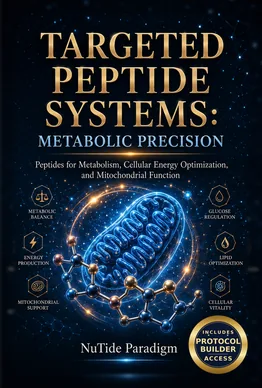
Metabolic Precision
Peptides for Metabolism, Cellular Energy Optimization, and Mitochondrial Function
Fat loss, glucose control and cellular energy, treated as one signalling system instead of a list of compounds. The incretins, the growth-hormone axis, and the mitochondria — and how they interact when you run them together.
$9.99Instant EPUB and PDF direct from the publisher. The 390-page paperback is printed to order and ships worldwide (shipping & returns). Educational purposes only. Not medical advice.
Everyone knows the compound names. Almost nobody knows the order.
You can find out what semaglutide does in about ten seconds. What you cannot easily find is what happens when it runs alongside a growth-hormone secretagogue, why the sequence matters, what it costs you in lean mass if you get the order wrong, and which biomarkers tell you it is going wrong before you feel it.
That is the gap this book was written for. Metabolic health is not one process — it is appetite signalling, insulin sensitivity, growth-hormone pulsatility and mitochondrial output, all pulling on each other. Treat them as four separate problems and you will fix one while quietly worsening another.
This book maps them as one system, places every compound on that map, and is candid about how much human evidence sits behind each one — including where it is thin.
You’ll get the most out of this if…
- You are already reading about GLP-1s and metabolic peptides and want the framework underneath the forum threads.
- You want to understand why a protocol is built the way it is, not just be handed one.
- You are past forty, the strategy that used to work has stopped working, and you want to know what actually changed.
- You care about keeping muscle while losing fat — the part most fat-loss material skips.
- You want the evidence graded honestly, including the compounds where the human data barely exists.
It is a framework book, not a set of instructions. It explains mechanisms, tradeoffs and reasoning — it does not tell you what to take, and it is not a substitute for medical care.
Ten sections, front to back.
- I Foundations of Metabolic Peptide Science
- VI Multi-Peptide Usage Dynamics and Systems Integration
- II Peptide Administration, Handling and Reconstitution
- VII Peptide Cycles, Timing and Optimization
- III Core Metabolic Peptide Categories and Applications
- VIII Long-Term Use Considerations and Risk Mitigation
- IV Individual Compound Profiles — Full Reference
- IX Case-Based Applications and Protocol Design
- V Bioregulators and Epigenetic Metabolic Modulation
- X The Future of Precision Metabolic Engineering
Plus the reference material
A quick-reference dosing table, consolidated appendix tables, protocol tracking worksheets, and sourcing guidelines.
Thirty-five profiles, sorted by what they act on.
Not an alphabetical list. Compounds are grouped by the part of the metabolic system they work on, so choosing one becomes a question of which mechanism you mean to reach.
1 — Incretin-class metabolic regulators
2 — GH-axis and body composition modulators
3 — Mitochondrial and cellular-energy compounds
4 — Antioxidant, cytoprotective and support compounds
5 — Metabolic bioregulators
Metabolic Precision
The complete book — all ten sections, every compound profile, the dosing table and the worksheets.
$9.99 Instant EPUB and PDF. Read it tonight.Want to try the framework first? The Protocol Builder and the Peptide Dose Calculator are free, with nothing to sign up for.
Questions.
Do I need to read the other books first?
No. Each book in the Targeted Peptide Systems series stands on its own and re-establishes the framework it needs. Book 1, Targeted Peptide Systems, is the foundation volume and goes wider across every system — but you can start here if metabolic health is what you actually came for.
Is this a dosing guide?
It is a framework book with a reference section. It explains what each compound acts on, how compounds interact, how cycles are structured and which biomarkers to watch, and it includes a quick-reference dosing table drawn from the published literature. It does not prescribe, and it is not a substitute for medical care.
Does it cover GLP-1s like semaglutide and tirzepatide?
Yes. The incretin class is the first of five compound categories and covers semaglutide, tirzepatide, liraglutide, retatrutide, cagrilintide, mazdutide, survodutide and tesofensine — including how they interact with the growth-hormone axis, which is where most protocols go wrong.
What formats is it available in?
Instant EPUB and PDF download direct from the publisher for $9.99. The 390-page paperback is printed to order and ships worldwide, for $29.99 plus shipping.
How current is the compound information?
Every compound in the series lives in a single database that also generates the compound library and the Protocol Builder on this site, so the book, the library and the tools describe each compound the same way rather than drifting apart. Evidence grades are stated on the compound itself rather than buried in a disclaimer.
One framework. Every system.
Metabolic Precision takes one system out of the foundation volume and goes as deep as a whole book allows. The others do the same for theirs.